Dane County Fair
July 19-22
Waukesha County Fair
July 18-22
Wisconsin State Fair
August 2-12
Sheboygan County Fair
Labor Day Weekend
August 30-Sept. 3
Wednesday, June 6, 2018
Monday, May 21, 2018
Wednesday, March 7, 2018
Schism in Evolutionary Theory Opens Creationist Opportunity
from ICR.org
Evolutionary biology is experiencing its most serious division over the structure of evolutionary theory since the development of the Modern Synthesis nearly 100 years ago. Last November, Great Britain’s prestigious Royal Society (The Royal Society of London for Improving Natural Knowledge) held a conference to deliberate if evolutionary theory needs to be “extended” or even renovated to accommodate fresh ideas from new discoveries. The article Schism and Synthesis at the Royal Society in the current issue of Trends in Ecology & Evolution by a conference organizer explains why “the discussion witnessed little meeting of minds.”1
The vital importance of this conference was framed in the science journal Nature in a point-counterpoint-style article, “Does evolutionary theory need a rethink?”2 They note that “researchers are divided over what processes should be considered fundamental.” A division over basic processes at the core of any theory suggests that the theory is incomplete, based on misleading research, or broken.
One researcher advocating for a major revision in evolutionary theory (modestly labeled the Extended Evolutionary Synthesis, or EES) is Kevin Laland of the University of St. Andrews. He said that “the data supporting our position gets stronger every day. Yet the mere mention of the EES often evokes an emotional, even hostile, reaction among evolutionary biologists. Too often, vital discussions descend into acrimony, with accusations of muddle or misrepresentation.”2 The bitterness, per Laland, is generated since “this is no storm in an academic tearoom, it is a struggle for the very soul of the discipline.”
*Dr. Guliuzza is ICR’s National Representative. He earned his M.D. from the University of Minnesota, his Master of Public Health from Harvard University, and served in the U.S. Air Force as 28th Bomb Wing Flight Surgeon and Chief of Aerospace Medicine. Dr. Guliuzza is also a registered Professional Engineer.
Image Credit: Copyright © 2017 The Royal Society. Adapted for use in accordance with federal copyright (fair use doctrine) law. Usage by ICR does not imply endorsement of copyright holder.
Article posted on May 18, 2017.



Tuesday, January 16, 2018
RNA Miracle

http://www.icr.org/article/10444
'RNA World' Paper Retracted
by Jeffrey P. Tomkins, Ph.D. *
The whole concept of how life originated is an insurmountable naturalistic hurdle. Life requires DNA, RNA, and protein in an interdependent triad in which each molecule is wholly dependent on the other two to exist. It’s worse than a chicken and egg scenario. Furthermore, since each type of molecule carries and conveys complex encoded information, an intelligent information provider is the only logical cause of this information source. Code implies a coder.
Shortly after the largely unfruitful origin of life research on amino acids by Miller and Urey in the 1950s,1scientist Alex Rich speculated in 1962 that RNA may have been the first biomolecule to spontaneously evolve. That first RNA biomolecule would possibly have both informational and enzymatic properties, thus omitting the original necessity of DNA and proteins.2 This idea slowly gained traction and eventually became more popular in the 1980s with discoveries that some types of RNA were involved in enzymatic-like reactions in the complex processing of RNA transcribed from genes. One of the main researchers in these discoveries was Scott Gilbert who coined the term “RNA World.”3
Since the late 1980s, researchers explored many aspects of the evolutionary possibilities related to RNA being the first biomolecule, but have found nothing but obstacles including no method of spontaneously forming RNA or its nucleotide building blocks. In fact, a secular scientist published a 2012 paper expressing this great frustration titled, “The RNA world hypothesis: the worst theory of the early evolution of life (except for all the others).”4
*Dr. Jeffrey Tomkins is Director of Life Sciences and earned his Ph.D. in genetics from Clemson University.
Article posted on January 15, 2017.
Wednesday, December 13, 2017
A Beautiful Story
Army atheist yells, ‘God save me’, as shells explode
This article arose from an exchange of information between CMI’s translations facilitator Roger Griffiths and John T. Tolbert, an evangelist working with several language groups in Asia, primarily Vietnamese.
Published: 12 December 2017 (GMT+10)

John recalls, as a five-year-old, looking up at the sky, and realizing there must be a God. At 17 years, he joined the US Army, which was engaged in the Vietnam War. During basic training, an older colleague, hearing that John believed in God, gave him Mark Twain’s Letters from the Earth, which lampoons the Bible. John says, “Not having read the Bible, I fell for it, and became an atheist.”
In March 1969, he arrived in Vietnam and became an interpreter of Vietnamese. That period in his life had a huge impact, because he discovered that when the shells were falling around him and people were getting killed, “I was running for the nearest bunker praying, ‘God save me’!”
Looking for life’s purpose
Honourably discharged in April 1970, John returned to the US and immediately enrolled at the University of Delaware. He was constantly discouraged by the fact that he did not know the purpose of life, or even if it had a purpose. If anyone sat down next to him at a bar, within minutes he would ask, “What do you think the purpose of life is?” No one had a satisfying answer.
John was so turned off by the Vietnam War that he decided to study political science. In the introductory course, he was enamoured with the reasoning and eloquent language of some Supreme Court opinions. Something about ‘truth’ captured his heart and he naïvely thought the study of law would lead him to the ‘truth’. So, after he received his B.A. in political science, at the age of 24 he decided to go to law school.
John says, “While a law student, I went to a Christmas Eve party. I left it about 2 am, drove out to the countryside, and parked near a big field. I walked out into the field and just stared up at the sky and the blinking stars. It seemed like a cold, lonely universe.” Then, as John thought about God, he began to cry, and called out, “God, I know you are there. Why can’t I know you? Send me a priest to tell me about you.”
Nothing happened. No meteors flashed through the sky. Dejectedly he walked back to his car and drove home. But God had heard that prayer.
John’s ‘priest’ arrives
John began to practise law in Delaware. One day, he was assigned a new client, a church pastor, and so met his ‘priest’. John observed that the pastor always brought a Bible with him, and prayed before making decisions about the case. What surprised John was that the pastor clearly seemed to think that someone was listening at the other end.
John was aware that the Bible taught a six-day creation, which was contrary to everything he had ever been taught. “So in my arrogance, and belief that I was smarter than the pastor, I decided to challenge him. One day when he came to my office, I picked up his Bible and said, ‘How can you believe in the Bible, when it’s wrong in the very first chapter’?”
He smiled, and said, “What do you mean, Mr Tolbert? Evolution?”
John replied, “Yes, evolution. Six-day creation. Noah’s Ark.”
“Come on!” He said, “You’re a lawyer, right?”
John said, “Yes.”
Then, he asked John a question that changed his life. He said, “Do you always form conclusions before you’ve studied both sides of the evidence?”
John was stunned, and said, “Are you saying there is evidence for a sudden creation, and against evolution?”
He said, “Quite a bit. Do you have an open mind?”
John replied, “Yes, I do.”
He said, “Ok. Next week I’ll send you some books written by PhDs in their fields, who don’t believe in evolution. They believe in a sudden creation by God, just as Genesis says.”
Sure enough, the next week, two people from his church brought a stack of books on creation and evolution. One of them was Beverly, whom he would marry three years later. But at that time, he was only interested in seeking ‘truth’.
As John read the books, he says he realized three things:
- Evolutionists, when pressed, seemed to admit that there was very little evidence to support their conclusions.
- The Genesis account of Creation and the Fall provided a serious, cogent explanation for the existence of the universe, and in many ways accounted for the sometimes horrible world in which we live.
- Genesis 3 provided the best explanation he had ever encountered concerning how there could be a ‘good’ God and a ‘terrible’ world.
Checking the sources
One morning in 1980, John took the books to the public library and began looking up the footnotes in the original sources (Nature, Science, Smithsonian, etc.). As John put it, “There was no distortion, twisting or misquoting. I slowly pushed my chair back from the table covered with all the original source materials, and said to myself, ‘Evolution is the biggest fraud that has ever been perpetrated upon the world. I have been deceived’.”
John then began to study the Bible, and about two to three months later, got down on his knees in his apartment and said to Jesus: “You are who I have been looking for, for 25 years. I am yours.”
“And that’s how I got saved,” John said. “It was obvious to me that the Scriptures taught a sudden creation in six 24-hour days. As a lawyer, I could reach no other conclusion. I had become convinced of the total reliability and inerrancy of the Bible.”
“I also was convinced that creation was recent,” John said. “Jesus said that ‘from the beginning of creation, God made them male and female’ (Mark 10:6), and He spoke of the blood of all the prophets shed ‘from the foundation of the world’ (Luke 11:50).”
Evangelism and translation
In 1999, a church in Maine called him to be their pastor, and in 2002, John and Beverly commenced eight years service in Vietnam with the Association of Baptists for World Evangelism (ABWE). In 2010, they moved to Taiwan to work among the Vietnamese there.
In addition to this evangelism work, John also leads a team of 10 Vietnamese native-speakers helping to translate the GotQuestions.org website (an apologetics site that also holds to six-24-hour-day creation) into Vietnamese. He has also helped proofread a portion of the articles translated into Vietnamese and featured on CMI’s website creation.com.1
In 2010, John wrote a 20-page tract called The Ancient Path, which has been printed in Vietnamese, Burmese, Chinese, and Nepali, with over 1,600,000 copies distributed. They are also working on getting it translated into the native tongues of some people groups in Asia that do not yet have the Scriptures translated. It answers the most common objection to Christianity in Asia—that Christianity is a Western religion.
John advises, “Virtually all Asians believe that Christianity is an American or Western religion. The idea of ‘sin’ clashes with ‘karma’, and so we have to deal with Buddhism and Hinduism. Most Asians just think that the universe ‘has always been there’. So in evangelism, starting with ‘the beginning’ is crucial (Luke 24:27).” The Ancient Path does this effectively, with pictures.
Inspired by this article?
John, who has been reading CMI’s articles for years, says this is “because they are so well-reasoned and well-documented”. He says, “There is no reason to abandon the historical and traditional view of Genesis 1. There is an infinitely powerful God who loves us, who created the entire universe in six days and then stopped creating. It’s as simple as that!”
John and Beverly are people who believe what God says, take Him seriously, and respond by using their talents to point others to God. It leaves a question for us: how are we using our talents to do likewise?
If you are fluent in a language other than English, perhaps you could help multiply CMI materials by becoming a voluntary CMI translator. Contact translations@creation.com.
Saturday, August 19, 2017
Noah and the Nodosaur
Dinosaurs and Dragon Legends
by Brian Thomas, M.S. *
"Look now at the behemoth, which I made along with you; he eats grass like an ox. See now, his strength is in his hips, and his power is in his stomach muscles. He moves his tail like a cedar; the sinews of his thighs are tightly knit. His bones are like beams of bronze, his ribs like bars of iron." (Job 40:15-18)
How do dinosaurs fit with the Bible’s history? They certainly existed—their fossil remains are found on every continent. And ancient historical records, including the Bible, chronicle human encounters with large reptiles whose descriptions best match dinosaurs. Could it be that these records show that dinosaurs and humans shared the earth at one time rather than living millions of years apart as evolutionary myth proclaims?
Dinosaurs certainly appear to be extinct now. Those that lived at the time of Noah’s globe-covering Flood drowned or suffocated (except those on board the Ark), as did all land-dwelling creatures with nostrils, according to Genesis 7:22. Fast-moving Flood mud quickly buried some of those outside the Ark. The mud layers covered the creatures’ dead bodies so deeply that scavengers couldn’t reach them, and the mud dried soon enough to preserve their remains as fossils faster than their carcasses could decay. Most, if not all, dinosaur fossil layers also contain fossil water creatures like fish and clams, and this fits the Flood explanation for their demise.
Although researchers have named hundreds of dinosaur species, all of them belong to only about 60 distinct families. These roughly equal the basic dinosaur kinds. That means Noah and his family only had to manage around 120 individual dinosaurs on the Ark...
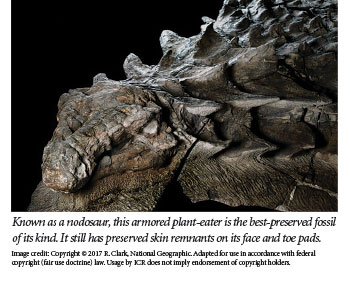
Adapted from “Dinosaurs and Dragon Legends” in Creation Basics & Beyond: An In-Depth Look at Science, Origins, and Evolution.
* Mr. Thomas is Science Writer at the Institute for Creation Research and earned his M.S. in biotechnology from Stephen F. Austin State University.
Cite this article: Brian Thomas, M.S. 2017. Dinosaurs and Dragon Legends. Acts & Facts. 46 (7)
https://www.icr.org/article/10071
Wednesday, August 16, 2017
And so we press on...
Belief in Creation Declines
by Brian Thomas, M.S. *
http://www.icr.org/article/10136
For generations, a large portion of Americans have believed that mankind began only thousands of years ago, not millions. A 2013 poll indicated that this next generation is finally beginning to depart from their forefathers’ creation-leaning beliefs.1 New Gallup results confirm this anti-Bible trend. Meanwhile, rhetoric about this trend reveals confusion over key issues.
The 2017 Gallup poll found that only 37 percent of Americans hold creationist views of human origins, down from 46 percent in 2012.2,3 This trend may reflect a change in generations, as younger Americans who are convinced of human evolution replace their more Bible-minded forebears. What does this trend mean?
Tom Krattenmaker from Yale Divinity School noted in USA Today that although more Americans believe in human evolution, they still identify as Christians. He wrote,
These tea leaves tell us that more people are refusing the all-or-nothing choice between faith and science and opting instead for a third way: Acceptance of the overwhelming scientific evidence for evolution while seeing a divine role in the process.4
This third way leads nowhere, since by definition evolution excludes the divine.
This perception of a divide between faith and science uses deceptive definitions of key terms. Many evolutionists like Krattenmaker define faith as believing as true that which has little or no supporting evidence. They assert that evidence demands our origins from apes and not Adam, while overlooking the fact that faith in evolution biased the way researchers interpreted that “evidence.”
*Mr. Thomas is Science Writer at the Institute for Creation Research and earned his M.S. in biotechnology from Stephen F. Austin State University.
Article posted on July 24, 2017.
Fossils formed recently?
Fossil Plants Contain Original Molecules
by Brian Thomas, M.S. *
Researchers shined a laser light on fossil leaves and found some surprising results. Instead of mere impressions of leaves, the fossils turned out to contain original molecules—persisting after millions of supposed years.
Research led by Lund University in Sweden used FTIR to find original molecular bonds still intact inside fossilized leaf wax. The technique detects stretches in specific chemical bonds.
Then the team compared the waxy cuticle that somehow persists in leaf fossils with the same cuticle molecules found in their living counterparts. Many of the scan results showed a match, even after all the years those fossils remained underground. The team published their results in Nature: Ecology & Evolution.1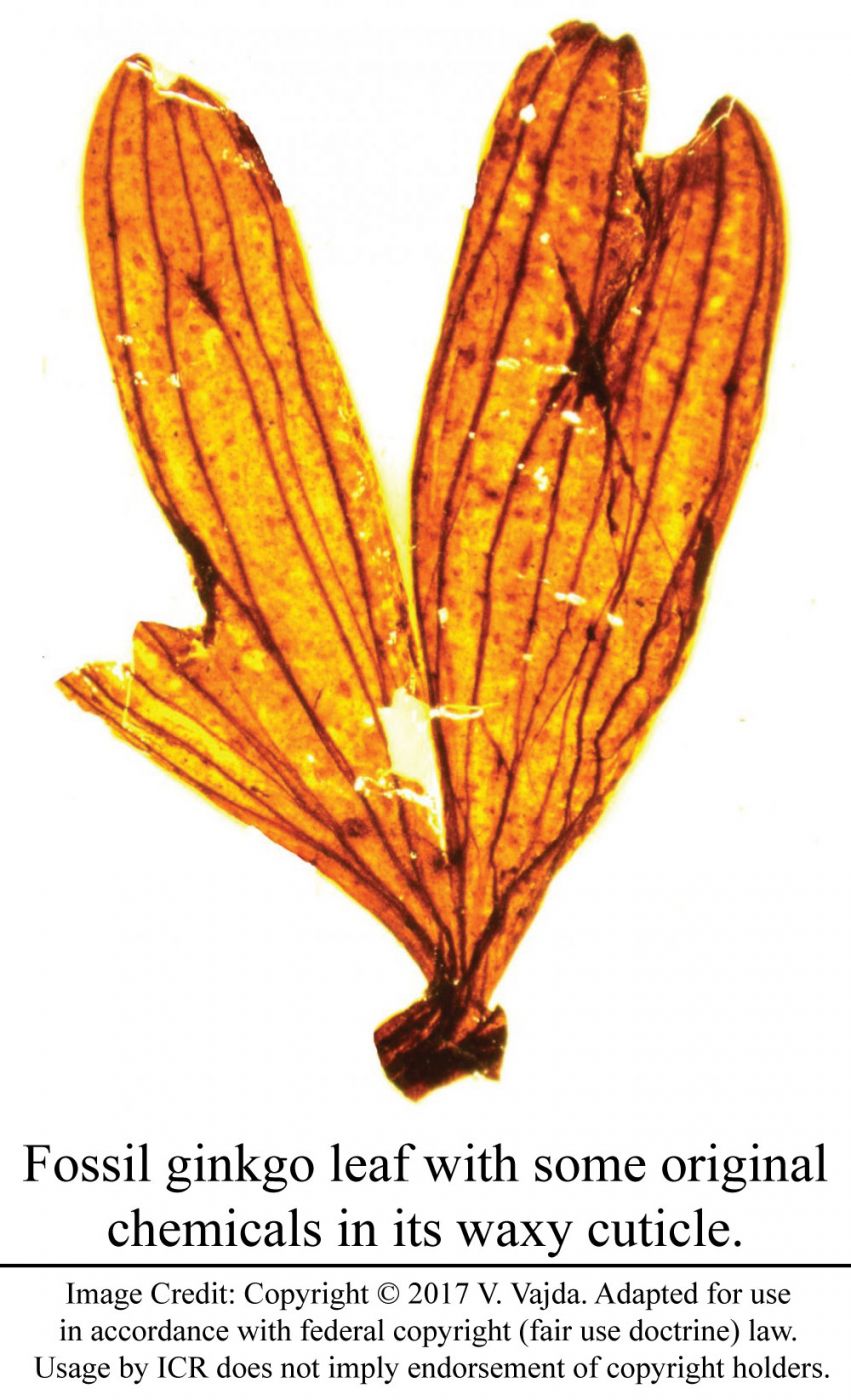
They scanned leaves from living Araucaria trees—tropical conifers that today grow in New Guinea, Australia, and Argentina—and from fossil Araucaria leaves locked in Cretaceous stone.
*Mr. Thomas is Science Writer at the Institute for Creation Research.
Article posted on August 3, 2017.
More Related Articles listed in article at ICR website (link above)
More Related Articles listed in article at ICR website (link above)
Tuesday, July 11, 2017
2017 Fairs
We hope to see you at the fair this summer. This is where we plan to set up our museum-like displays and have some great conversations:
July 19-23
Dane County Fair
Waukesha County Fair
August 3-13
Wisconsin State Fair
We will be in a new location this year. Our location is the Central Marketplace near the Bank Mutual Stage.
August 31-Sept 4
Sheboygan County Fair
July 19-23
Dane County Fair
Waukesha County Fair
August 3-13
Wisconsin State Fair
We will be in a new location this year. Our location is the Central Marketplace near the Bank Mutual Stage.
August 31-Sept 4
Sheboygan County Fair
Subscribe to:
Posts (Atom)