Characteristically, Dr. Menton's humor and superior knowledge of Biology make this a wonderful video to watch. It is done in three, 15 minute parts. At the end of the third part he explains why dinosaurs could not have evolved from birds, and he uses some incredible microscopic images. Enjoy!
Does Biology Make Sense Without Evolution?
Showing posts with label What You May Not Know about Evolution. Show all posts
Showing posts with label What You May Not Know about Evolution. Show all posts
Thursday, April 12, 2012
Sunday, April 8, 2012
Programming of Life
Loving God or random evolution? Please watch this compelling video... Programming of Life: What's the evidence?


Wednesday, November 9, 2011
Seminar Success
23 guests attended our first one-night seminar on the Age of the Earth and Carbon Dating at the West Bend library. Feedback included comments like:
Very thought-provoking, interesting and relevant, good explanation of carbon dating, very good presentations, great information, riveting, and excellent explanation about underlying assumptions of carbon dating...
Attendees took home the DVD, God of Wonders, and other resources for themselves and to share.
Thank you Randy and Joe for your wonderful presentations!
We are considering a one-night seminar this winter on the topic of dinosaurs.

Monday, August 15, 2011
ICR writes Great Rebuttal to Evolutionary Comments about "What's the Evidence?" Booth and Interpretation of Scientific Data
County Fair's Creation Booth Smeared by Media
by Brian Thomas, M.S. *
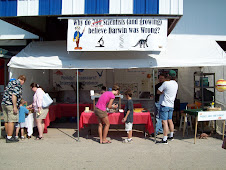
A part-time nurse from West Bend, Wisconsin, set up an interactive creation-based booth with a sign reading "Interpret the Evidence" at a local county fair. The Wisconsin State Journal reported on Mary Weigand's booth with the headline "Creationist seeks to debunk scientific fact at Dane County Fair."1 But was she actually trying to debunk "scientific fact," or was this headline just a mudslinging smear?
By examining fossils on display, booth attendees investigated for themselves whether or not fossils show a gradual transition between life forms, as Darwinism predicts. The booth presented an alternative scientific explanation that appears to fit the fossil data much better. Each visitor was left to discern whether fossils show discrete created kinds with no undisputed transitions between forms, as biblical creation predicts.2The news response to this booth claimed that the idea that the world is thousands of years old is incompatible with "techniques such as radioactive isotope dating." Supposedly, these techniques "repeatedly conclude that some geological features are hundreds of millions of years old."1 But what if overwhelming scientific evidence actually demands that the world is thousands, not millions or billions, of years old, and that the radioisotope dating techniques are unreliable? Weigand may well be familiar with these reports, unlike the State Journal reporter and the evolutionists he interviewed.
Scientific evidence has clearly shown radioisotope dating to be completely untrustworthy.3 Radioisotope-derived ages are typically in conflict with other published results that use different isotopes, or even the same isotopes published at different times. Radioisotope age assignments of rock samples of known age have always reported at orders of magnitude older than the real age of the rock. For example, a 10-year-old rock that formed in the crater of Mount St. Helens was dated at 350,000 years, while another technique dated the same rock at over two million years.4
A Wisconsin-based evolutionary botanist said that the booth "is a testament to the power of belief and the difference between belief and science."1 But his statement is wrong, because it assumes that science does not involve belief, when in fact belief is a fundamental requirement for operational science. Prior to investigation, any scientist must first believe that the world operates according to regular principles, that his or her study results will meaningfully correlate to reality, and that there is such a thing as truthful reality. These beliefs find their foundation only in biblical Christianity.5
The assertion that science is separated from belief also wrongly assumes that belief in creation does not involve scientific examination of evidence. This assumption is convenient if a person prefers to ignore the reams of scientific evidence that point to recent, special creation.6
The claim that this booth is attempting "to debunk scientific fact" is apparently a shallow slander. Instead, it looks as though Weigand and her sponsors actually promote just the opposite approach: Encouraging people to do better science by interpreting hard evidence using common sense, instead of relying on the dogmatic propaganda that is necessary to prop up evolution's failed paradigm.
References
- Erickson, D. Creationist seeks to debunk scientific fact at Dane County Fair. Wisconsin State Journal. Posted on host.madison.com July 22, 2011, accessed August 5, 2011.
- For more information, see Fossils Show Stasis and No Transitional Forms on www.icr.org.
- For one example, see Humphreys, D. 2006. A Tale of Two Hourglasses. Acts & Facts. 35 (12). Related articles are available at www.icr.org/creation-radiometric.
- Austin, S. A. 1996. Excess Argon within Mineral Concentrates from the New Dacite Lava Dome at Mount St. Helens Volcano. Journal of Creation, formerly Creation Ex Nihilo Technical Journal. 10 (3): 335-343.
- Lisle, J. 2009. The Ultimate Proof of Creation. Green Forest, AR: Master Books, 39-41.
- For a sampling of this evidence, visit the Evidence from Science site on www.icr.org.
* Mr. Thomas is Science Writer at the Institute for Creation Research.
Link to article
Link to article
Monday, February 7, 2011
The Incredible, Edible Egg............
The Incredible, Evangelistic Egg
by Kirk Cameron
May 19, 2008
Have you ever stopped to consider that there’s more to an egg than how good it tastes? It’s like a little space capsule. Inside the capsule, two lifelines tether a tiny astronaut (the chick) to the food supply (the yellow part called the yolk) and the outside oxygen source.
10,000 tiny holes in the capsule’s shell allow oxygen to come in and carbon dioxide wastes to go out. The shell is also coated with something called “bloom,” which keeps dust out of the holes and fights bacteria.
As he grows, the astronaut is strapped safely into the center of the capsule by two strong bungee cords attached to opposite ends of the shell. He is further protected by a dense, shock-absorbing liquid (the “white” of the egg) filled with protein and a powerful enzyme called lysozyme.
Also found in human tears, this enzyme kills bacteria on contact. This germ-buster explains why our eyes don’t become infected, even though they are constantly exposed to bacteria.
A few days before the astronaut emerges from the capsule, a special tool grows on the tip of his beak called an “egg tooth.” He first uses this tool to open a special air sac in the capsule, which gives him six hours of oxygen, which he desperately needs before breaking out. Fueled with this oxygen, the little fellow uses his egg tooth to crack the shell of the capsule and spring forth into a new world.
The day before he hatches, he swallows the entire food pack (the yolk), giving him three days of food and water before he gets on his feet and finds nourishment on his own. Clearly, the egg is a marvel, designed by a creative genius.

Photo courtesy of Kirk Cameron
Just open the fridge and say to your friend, “Hey . . . have you ever seen a miniature space capsule?” Then let him hold the egg, as you share with him what you’ve learned. Use the egg as a springboard to talk about the genius of our wonderful Creator, and show your friend how to know Him through faith in Jesus Christ.
, husband and father of six, is best known for his roles in the TV series hit Growing Pains and in the Left Behind movie series. Kirk’s newest role is in the upcoming film Fireproof from Sherwood Pictures, set to release this August.
Wednesday, May 19, 2010
Anniversary of Mount St. Helens Eruption
Thirtieth Anniversary of a Geologic Catastrophe
by Andrew A. Snelling
May 18, 2010
May 18 marks the thirtieth anniversary of one of the most violent natural disasters of our time, the colossal 1980 eruption of Mount St. Helens. This catastrophic geologic event not only shocked the world because of its explosive power and made headline news, but challenged the foundations of evolutionary theory.
The May 18, 1980 eruption of Mount St. Helens in the state of Washington is regarded by many as the most significant geologic event of the twentieth century, excelling all others in its extraordinary documentation and scientific study. Although not the most powerful explosion of the last century, that eruption provided a significant learning experience within a natural laboratory for the understanding of catastrophic geologic processes. And thirty years later we learn that Mount St. Helens still confronts the underlying slow-and-gradual assumptions of modern geologic thinking.

The beautiful mountain before it erupted thirty years ago today. (Photo by R. Fleshman from www.creationism.org)

Today’s Mount St. Helens (Photo by R. Fleshman from www.creationism.org)
On May 18, 1980, a steam blast equivalent to 20 megatons of TNT destroyed the northern side of the once-pristine shape of the volcano. Geologists, who are accustomed to thinking about slow evolutionary processes forming geologic features, were astounded to witness many of these same features form rapidly as a result of that and subsequent eruptions. We are indebted to Dr. Steven Austin of the Institute for Creation Research for his work in documenting carefully the geologic results of this astounding catastrophe. The following undeniable lessons still confront us, thirty years on.
To continue article go to this link:
http://www.answersingenesis.org/articles/2010/05/18/thirtieth-anniversary-of-geologic-catastrophe
Friday, April 23, 2010
EARTH DAY
My sister works in a day school in Southern Texas. She gave her kids aloe plants for Earth Day. I thought it a nice gesture, after all, it was the Lord who created the heavens and the earth and all the wonderful plants we see on earth.
I found a good article that puts Earth Day into perspective:
http://www.answersingenesis.org/articles/2010/04/22/earth-day-creationist-perspective
And this link to a new DVD that sounds fascinating:
http://www.themysteriousislands.com/
On the day some have named Earth Day, I planted spinach, radishes and lettuce in my garden. But I would have planted them regardless of the day having a name. It was a beautiful day!
Monday, January 25, 2010
I shouldn't have been surprised!
 Someone I know is taking a music theory class at a state university. Now, you'd think the class would be about chords, triads, music scales, etc. Well, it was, save a comment by the professor regarding gills and ear bones evolving in amphibians and man.
AMAZING. A professor can make an unsubstantiated comment like that, AND WHO WOULD KNOW that there isn't a shred of evidence to back up his comment.
When I saw this cartoon on the Answers in Genesis website, I thought I'd pass this on......................
Have a good one!
Mary

Thursday, January 7, 2010
Things You May Not Know About Evolution by Henry Morris, Ph.D.
The word "EVOLUTION" can mean different things to different people. In fact, it seems that misunderstanding about the term is common. Dr. Henry Morris does a really nice job explaining what evolution is. I'll share more articles in the future to help clarify the term and shed light on some common misconceptions from the media. Once a person understands what evolution really is, it is easy to see its impossibility.
http://www.icr.org/article/things-you-may-not-know-about-evolution/
Enjoy the beautiful snow!
Mary
http://www.icr.org/article/things-you-may-not-know-about-evolution/
Enjoy the beautiful snow!
Mary
Monday, January 4, 2010
Treasures of the Snow
After traveling to Northern Wisconsin last week and enjoying the beautiful snow and scenery I was reminded of the verse in Job that speaks of "treasures of the snow". While we who live in the frozen tundra often complain about winter, God has a plan for...........yes, even snow. He knew that those of us living after the flood would need different ways to survive in the harsh climates that were not a part of His perfect creation and climate in the pre-flood world. Dr. Henry Morris touches on some ways snow is beneficial to us. It is a fun little article:
http://www.icr.org/article/20090/
http://www.icr.org/article/20090/
Tuesday, December 29, 2009
The Amazing, Living Cell and the Complexity of Healing. Only by Design.....
Pioneering Adult Stem Cell Treatment Helps Man Recover Sight After 15 Years
London, England (Lifenews.com) -- A man who was partially blinded when ammonia was squirted in his eye during an attack 15 years ago has regained his sight after receiving a pioneering stem cell treatment, according to a London Guardian report. Russell Turnbull, 38, suffered massive damage to his right eye when he was caught in a scuffle after a night out in Newcastle in 1994. On the bus home, Turnbull had tried to intervene in a fight between two men but was injured when one of them began squirting passengers with ammonia. The chemical severely scarred Turnbull's cornea, the clear membrane that covers the front of the eye, and destroyed stem cells that usually help keep the cornea healthy. "I was in unbearable pain. It burned my eye shut," Turnbull told the Guardian. "I was in hospital for two weeks and eventually I was able to open the eye again. It was like looking through scratched perspex." Turnbull was left with "limbal stem cell deficiency" (LSCD), a condition that seriously impairs sight, and was in pain every time he blinked or saw bright lights. In an experimental treatment devised by doctors at the North East England Stem Cell Institute in Newcastle, stem cells were taken from Turnbull's healthy eye and grown on a layer of amniotic tissue, which is routinely used as a burn dressing. The NHS banks amniotic sacs donated by women who have had a Caesarean section. When the cells had covered the membrane, a piece the size of a postage stamp was transplanted onto Turnbull's damaged eye. Two months later the membrane had broken down, leaving his damaged eye with a fresh supply of healthy stem cells, which repaired the cornea. Eye tests six months after surgery showed that Turnbull's vision was nearly as good as it had been before the attack.
London, England (Lifenews.com) -- A man who was partially blinded when ammonia was squirted in his eye during an attack 15 years ago has regained his sight after receiving a pioneering stem cell treatment, according to a London Guardian report. Russell Turnbull, 38, suffered massive damage to his right eye when he was caught in a scuffle after a night out in Newcastle in 1994. On the bus home, Turnbull had tried to intervene in a fight between two men but was injured when one of them began squirting passengers with ammonia. The chemical severely scarred Turnbull's cornea, the clear membrane that covers the front of the eye, and destroyed stem cells that usually help keep the cornea healthy. "I was in unbearable pain. It burned my eye shut," Turnbull told the Guardian. "I was in hospital for two weeks and eventually I was able to open the eye again. It was like looking through scratched perspex." Turnbull was left with "limbal stem cell deficiency" (LSCD), a condition that seriously impairs sight, and was in pain every time he blinked or saw bright lights. In an experimental treatment devised by doctors at the North East England Stem Cell Institute in Newcastle, stem cells were taken from Turnbull's healthy eye and grown on a layer of amniotic tissue, which is routinely used as a burn dressing. The NHS banks amniotic sacs donated by women who have had a Caesarean section. When the cells had covered the membrane, a piece the size of a postage stamp was transplanted onto Turnbull's damaged eye. Two months later the membrane had broken down, leaving his damaged eye with a fresh supply of healthy stem cells, which repaired the cornea. Eye tests six months after surgery showed that Turnbull's vision was nearly as good as it had been before the attack.
I wish my apple trees were disease resistant!
As a lover of my fruit trees I found this article interesting. Again, the evidence in biology points to Genesis. Read on...
http://www.icr.org/article/5134/
http://www.icr.org/article/5134/
Fresh Salamander Tissue found in Solid Rock
When I read articles such as this one I am amazed that so called scientists continue to embrace the millions of years ideology. Many similar finds such as what has been reported here point to catastrophe-recently and pointing to the events of "Noah's flood" (Genesis 6-9).
http://www.icr.org/article/5117/
Mary
http://www.icr.org/article/5117/
Mary
Monday, December 28, 2009
Dinosaurs!
For my very first posting on the What's the Evidence? blog I will share an article on a topic that captures the imagination of adults and children alike. ENJOY!!
http://www.answersingenesis.org/articles/am/v5/n1/living-large
I hope this link works for you. This is my maiden voyage into blogging.
Happy New Year!
Mary
http://www.answersingenesis.org/articles/am/v5/n1/living-large
I hope this link works for you. This is my maiden voyage into blogging.
Happy New Year!
Mary
Subscribe to:
Posts (Atom)