Thursday, July 16, 2015

Pluto and the Solar System

Today, more than nine years after its launch, the New Horizons spacecraft is scheduled to make its closest approach to the dwarf planet Pluto.1 This will make New Horizons the first space probe to closely examine Pluto and its moons during this flyby. A NASA press release states, "A close-up look at these worlds from a spacecraft promises to tell an incredible story about the origins and outskirts of our solar system. New Horizons also will explore—for the first time—how ice dwarf planets like Pluto and Kuiper Belt bodies have evolved over time."2
But scientific data do not tell stories—people do—and this Pluto tale will result from people's interpretation of the data. For this reason, it would be more accurate to state that secular scientists are hoping that data collected by New Horizons will enable them to tell a story about how the solar system came into existence. And although they do not say so explicitly (perhaps they don't wish to offend the American taxpayers who provide NASA's funding), there is little doubt they fully intend for this story to leave no room for a supernatural Creator.
But of course, such a claim is a tacit admission that they do not yet have in hand a plausible secular explanation for the solar system's origin, notwithstanding a barrage of misleading claims in popular science television shows and magazines.
The New Horizons spacecraft is intended to yield information about "Kuiper Belt bodies." What are these, and why are they important to secular scientists? The answer involves comets.
Comets are essentially "dirty snowballs" that orbit the sun. Secular scientists believe that comets are leftover materials from the solar system's formation some 4.5 billion years ago. Because it is a "dirty snowball," a comet loses some of its mass every time its orbit takes it close to the sun, not unlike an ice cream cone exposed to a heat lamp. Comets lose their mass so rapidly that no comets should exist at all today if the solar system really were billions of years old!
Secular scientists are well aware of this problem and have proposed two sources to replenish this dwindling comet supply. The Kuiper Belt was proposed to be a disk of trillions of comet-sized icy bodies orbiting beyond Neptune. Secular astronomers believe that, from time to time, some of these icy bodies are disrupted from their orbit and redirected into the inner solar system where they become comets. This Kuiper Belt is thought to serve as a source for short-period comets—those that require less than 200 years to make a single orbit of the sun.
The second of these supposed sources is the "Oort Cloud," an enormous reservoir of comet nuclei thought to surround our solar system, but (conveniently) located too far away to be seen, even with our most powerful telescopes. The Oort Cloud is said to be a source for long-period comets—those having orbital periods greater than 200 years.
One major problem with the Oort Cloud is that there is zero observational evidence that it even exists! The Oort Cloud is purely hypothetical.
Does the Kuiper Belt exist? Instead of finding trillions of comet-sized bodies, astronomers instead discovered hundreds of much larger objects (such as Pluto and its moons) that exist beyond Neptune's orbit at the outer edges of our solar system. But to replenish the solar system's comets, a Kuiper belt would need to contain many more icy bodies than the mere hundreds which have so far been observed. Moreover, these observed objects are much larger than typical comet nuclei.3 Hence, it is rather misleading to refer to these objects as "Kuiper Belt bodies," since they are too large and exist in far too few numbers to actually constitute the kind of Kuiper Belt that secularists were expecting! Hence, a more scientifically accurate term for these bodies is "Trans-Neptunian Objects," or "TNOs."
But if neither the Oort Cloud nor a Kuiper Belt of trillions of comet-sized masses exist, then secular scientists have no explanation for how comets could continue to exist in a 4.5 billion year-old solar system. But comets can exist in a solar system that is only about 6,000 years old, even without a Kuiper Belt or an Oort Cloud.
Secular scientists hope that new data will help them craft a story and explain the solar system apart from the Lord's handiwork, but these efforts have a way of backfiring on them. One is reminded of Psalm 76:10, which says, "Surely the wrath of man shall praise You . . . ." Rather than weakening the case for creation, data collected by previous spacecraft have only strengthened the case that our solar system was designed and is much younger than the age of 4.5 billion years that secular scientists have assigned to it.4,5 Christians should not be surprised if data collected by the New Horizons spacecraft continues this trend.
References
  1. In 2006, Pluto lost its status as a planet and was reclassified as a "dwarf planet."
  2. Talbert, T. 2015. New Horizons: The First Mission to the Pluto System and the Kuiper Belt. Posted on nasa.gov June 16, 2015, accessed July 8, 2015. 
  3. Lisle, J. 2014. The Solar System: Pluto. Acts & Facts 43 (4): 10-12. 
  4. Hebert, J. 2013. Youthful Solar System Bodies Puzzle Evolutionary Scientists. Creation Science Update. Posted on icr.org February 13, 2013, accessed July 8, 2015.
  5. Psarris, S. 2009. What You Aren't Being Told About Astronomy: Our Created Solar System. Creation Astronomy, DVD. This widescreen DVD presents this information in the form of a delightful tour of our solar system. Available at the ICR online store: store.ICR.org.
Image credit: 2015 NASA. Public domain. Adapted for use in accordance with federal copyright (fair use doctrine) law. Usage by ICR does not imply endorsement of copyright holder.
*Dr. Hebert is Research Associate at the Institute for Creation Research and received his Ph.D. in Physics from the University of Texas at Dallas.
Article posted on July 14, 2015.

Friday, June 26, 2015

Summer 2015 Fairs

Dane County Fair
Madison, WI
July 15-19

Waukesha County Fair
Waukesha, WI
July 15-19

Wisconsin State Fair
Milwaukee, WI
August 6-16

Sheboygan County Fair
Plymouth, WI
September 3-7 (Labor Day Weekend)

Wednesday, April 22, 2015

From the Grand Canyon to South Africa, Evidence Abounds for Noah's Flood

Cape Peninsula sandstones, South Africa, deposited during Noah’s Flood

Published: 26 July 2012 (GMT+10)
georneys.blogspot9
Maroon mudstone beds and buff sandstone beds alongside Chapman’s Peak Drive south of Cape Town.
In the steep road cut alongside Chapman’s Peak Drive, south of Cape Town, South Africa, you can see some of the flat-lying beds of sediment that form the 1000-metre (3000-ft) tall mountains along Cape Peninsula. The mudstone has a distinctive maroon colour while the coarser sandstone is buff. The road runs just above the contact between the sandstone and the underlying granite.
Geologists have called these sediments the Graafwater Formation, which is around 70 metres (200 ft) thick along Chapman’s Drive.1 Above it sits another 550 metres (1800 feet) of sedimentary strata, the Peninsula Formation, which lacks the distinctive maroon mudstone layers.2 The Peninsula Formation forms the impressive cliff faces prominent in Table Mountain and the escarpments above Chapman’s Peak Road.2
There are many features of these sandstone deposits on the peninsula that point to large-scale, rapid deposition
There are many features of these sandstone deposits on the peninsula that point to large-scale, rapid deposition, as you would expect during Noah’s global Flood.
  1. The sediments cover a large geographical area. McCarthy and Rubidge have a geologic map that shows the Table Mountain Group extending beyond Port Elizabeth, 700 km (400 miles) to the east, and almost as far as Vanrhynsdorp, 300 km (200 miles) to the north.3 This points to a geologic process that covered a very large area, as would be expected from Noah’s Flood.
  2. The sandstone beds are “amazingly uniform”.2 This feature can be seen in the above image of the road cut, but also from a distance when you look at the escarpments in the area, such as the escarpment of Table Mountain or of the Twelve Apostles. Once again, this points to an energetic geologic process that covered a large area.
  3. The sandstone beds are frequently quite thick, some as thick as 6 metres (20 feet).4 This points to a large water flow with abundant sediment, again as would be expected from the Flood catastrophe.
  4. The continuous nature of the sedimentation indicates continually rising sea level. There is no evidence of erosion or a break in deposition at the contact between the two formations, so geologists believe that the sediments represent a process of continuous deposition.5
  5. Sedimentary structures indicating flowing water are common, including large trough and tabular cross bedding.6
  6. Abundant wave and ripple marks, again indicating flowing water.6
  7. The sedimentary beds show evidence of slumping, including load casts.6 Imagine how a billiard ball placed on a layer of soft mud would sink into the mud. When sand is deposited onto soft sediment, blobs of sand will sink into the underling mud forming ‘load casts’. These features indicate deposition so rapid that the sediments are still uncompacted and loose.
  8. Well rounded quartz pebbles up to 70 mm (3 inches) in diameter are distributed through the sandstone, sometimes forming thin lenses of pebble conglomerate.6 These stones give an idea of the water flow needed to carry them along.
Finish reading HERE

An Old Earth or a Global Flood

By Russ Miller at Creationministries.org

Monday, March 16, 2015

Bilblical Creationists Among Best Scientists

Einstein’s Heroes—biblical creationists


There’s little doubt that the most famous scientist of the 20th century was Albert Einstein (1879–1955). Today his name is synonymous with ‘genius’. Most people today would recognize his most famous equation, E=MC2, (though many would be hard-pressed to explain what it actually means!). But even Einstein had his science heroes.
So whom would the great Einstein have admired? They must have been incredible scientists for Einstein to have thought highly of them! And they were. Einstein had pictures of his three heroes of science on his study wall.1 They were Isaac Newton2 (1642–1727), Michael Faraday3 (1791–1867), and James Clerk Maxwell4 (1831–1879).
But these three men also had another thing in common—they were all Bible-believing creationists.
All three men were deserving of Einstein’s veneration. Newton’s laws of motion and his notion of gravity were the first ideas that successfully unified ideas about the motions of the stars, planets, and the earth. Faraday is widely regarded as the greatest experimenter of all time. His work involved showing that magnetism could produce electricity, and discovering benzene, among many other things. Maxwell discovered the four fundamental equations of electricity and magnetism, and predicted electromagnetic radiation at a certain enormous speed. Light was measured to have that speed—300,000 km (186,000 miles) per second—showing that light was electromagnetic radiation. Without their discoveries, we wouldn’t have much of the technology we have today. Practically everything involving moving parts, electricity, and magnetism can in part be attributed to the work of these three men.
But these three men also had another thing in common—they were all Bible-believing creationists. By today’s standards all three would be regarded as ‘fundamentalists’. Newton wrote more on theology than he ever did on science, believing the Bible to be God’s Word. Faraday was a member of a very conservative offshoot of the Church of Scotland, the Sandemanians. The Sandemanians were known for their plain interpretation of the Bible. A recent book said:
“A member of a gentle Christian sect, the Sandemanians, Faraday was deeply religious and viewed science—exploration of nature—as an extension of his heartfelt faith.
“Although we in the 21st century debate the conflict of science and religion, Faraday saw no such division. “‘The book of nature, which we have to read, is written by the finger of God,’ he wrote. For Faraday, ‘unravelling the mysteries of nature was to discover the manifestations of God.’”5
Maxwell was widely read in theology. He interacted with many of the best theological minds of his day, always as a solid evangelical Christian. In fact, he often chided other believers for tying religious truth too tightly to the science of the day. He understood this not as a problem for God’s unchanging Word, but as a problem for man’s ever changing understanding of how the world works.
Maxwell’s faith in the Bible even shocked a young Karl Pearson6 who, when he questioned the Flood, was reprimanded by Maxwell for questioning the Bible!
“The conversation turned on Darwinian evolution; I can’t say how it came about, but I spoke disrespectfully of Noah’s Flood. Clerk Maxwell was instantly aroused to the highest pitch of anger, reproving me for want of faith in the Bible! I had no idea at the time that he had retained the rigid faith of his childhood, and was, if possible, a firmer believer than Gladstone7 in the accuracy of Genesis.”8
Newton, Faraday, and Maxwell were not biblical creationists for nothing.
Sadly, Einstein did not share the spiritual convictions of his heroes. Like many in his day and now, he felt free to abandon the biblical God.9 Little did he know that for all his great work he was operating on borrowed assumptions. Newton, Faraday, and Maxwell were not biblical creationists for nothing. They understood that the only reasonable ground for the amazing regularity we find in the natural world is the orderly and unchanging God of Scripture. They understood that the assumptions of science,10 which only find their grounding in God, cannot be separated from the history11 to which He has testified. And they understood that His Word is surer than the foundations of the universe, including the laws that govern it. They sought to think God’s thoughts after him.
Einstein’s heroes have a lot to teach us. The world is ordered because God orders it. God’s Word doesn’t change and is always trustworthy, unlike man’s scientific theories. But good science will always square with Scripture—they both come from the same God, after all. They also teach us that far from being opposed to science, biblical creation is its solid foundation.

Article from Creation.com HERE

Thursday, February 12, 2015

DNA-Evidence for Creation

February 24, 2015
6:45pm


Jay Seegert

Evolution: Probable or Problematic?

Creation in 6 Days?
 
Location:
Kettle Moraine Bible Church
204 S. 7th Ave.
West Bend, WI

Evolution: Probable or Problematic?

Jay will demonstrate that various aspects of evolution actually seem fairly plausible to many people, including Christians.  For example, a fish slowly turning into an amphibian… with the fins being slightly modified into short legs/feet and being able to crawl up on land and breath air.  So from a certain distance or vantage point, things can appear to be quite plausible or look very good.  However, when you “look under the hood” you see a completely different picture.
 
In this talk, Jay will “take a look under the hood” regarding what actually has to happen genetically in order for a single cell organism to change into a human being.  He will show how DNA works and point out a serious problem with the concept of evolution.  By the end of the lecture, the audience sees how utterly impossible molecules-to-man evolution really is, even though portions of their story occasionally seem plausible.

Creation in Six Days? - A Biblical and Scientific Analysis

There is a lot of debate and confusion over the length of the “days” in the Genesis creation account. The most straight-forward interpretation seems to indicate they are normal solar days, but this would be in conflict with the view common amongst most astronomers and other scientists that the universe is almost 15 billion years old. In this talk, both Scripture and science are examined and reasons for why we can confidently trust the straight-forward reading are presented in a very gracious and encouraging manner.

About the Speaker:
Jay Seegert is the Co-Founder & Principal Lecturer for the Creation Education Center (CECwisc.com), as well as a former national speaker for Creation Ministries International.  He also served as President of the Creation Science Society of Milwaukee, Inc. for 3 years.

Jay is an Ambassador and Board Member of Logos Research Associates and is also a speaker for Ratio Christi.

Jay has degrees in Physics and Engineering and has been speaking on the Creation/Evolution controversy for over 25 years.

Monday, December 22, 2014

What does Christmas have to do with Poisonous Snake Venom?

Unlocking the Origins of Snake Venom


The origin of snake venom has been a long-time mystery to both creationists and evolutionists. Interestingly, new research confirms that the same genes that encode snake venom proteins are active in many other tissues.1
According to the biblical record, God’s creation was originally void of death, disease, and violence. Because of Adam and Eve’s rebellion, the whole of creation became subject to a curse that resulted in snakes with venom, stinging arthropods, and countless diseases. One of the chief questions facing creation biologists and geneticists is how venom was manifested in the genomes and cellular biology of creatures. A new scientific model that explains this paradox is gaining credibility thanks to a variety of studies in different types of organisms.2,3 In this model, genes and their regulatory sequences have either been corrupted and/or lost through genome degradation to bring about scenarios in nature that seem to defy the original harmonious purpose of God’s creation.
In a published study earlier this year, scientists took a fresh approach and looked for explanations of snake-venom origins outside the standard evolutionary paradigm. According to evolutionary ideas, it was believed that new venom genes were produced by the duplication of other standard body genes.3,4 In their work, the researchers analyzed gene expression in venom glands and other body tissues in a wide variety of venomous and non-venomous snakes, and even the gecko.
In stark contrast to the typical evolutionary story, the researchers stated, “We find the hypothesis that snake venom evolves through the duplication of physiological or body genes and subsequent recruitment into the venom gland to be unsupported by the available data,” and, “Indeed for a large number of the gene families claimed to have undergone recruitment we find evidence of a diverse tissue expression pattern, including the salivary gland of nonvenomous reptiles.” The significance of this finding indicates that venom genes are not the products of alleged evolutionary processes, but are important DNA sequences that also serve other purposes in a variety of reptile tissues.
In this new study, researchers used a comprehensive set of 24 reptilian venom gene families and compared them to the non-venomous Burmese python genome along with the gene expression datasets from 12 different python tissues.1 This research confirmed the emerging paradigm revealed by the previous study that the genes that encode venom proteins are actually expressed in many different bodily tissues, and are not specific to venom glands. The difference regarding venom glands is that the genes that encode venom proteins are typically expressed in much greater quantities. This explains the dosage-dependent toxic properties in venom, which is used to immobilize and kill prey. What the physiological purpose of these proteins produced at lower concentrations in other bodily tissues is still largely unknown because it has not been investigated.
Interestingly, the study prior to this also showed that the elevated expression of venom genes was likely due to the genetic corruption of regulatory DNA sequences that act like switches, which ultimately regulate the levels of venom proteins in specific tissues.3,4 Creation scientists would predict this type of scenario resulting from the corruption of genetic information.
These two studies demonstrate that venom genes are likely serving other non-venomous purposes in reptile tissues, and the toxic levels of venom proteins found in modern venomous snakes is probably due to an alteration of regulatory sites in the DNA, causing them to be highly expressed in venom glands (as described in the first publication). This type of genetic model is predicted by creationists who understand the concept that genomes have undergone a process of information corruption, not vertical evolutionary improvement, a process initiated when the creation became cursed.
References
  1. Reyes-Velasco, J. et al. 2014. Expression of venom gene homologs in diverse python tissues suggests a new model for the evolution of snake venom. Molecular Biology and Evolution. MBE Advance Access. Published Nov 4, 2014.
  2. Tomkins, J. 2014. Fungal Parasitism Marked by Gene Loss, Not Gain. Creation Science Update. Posted on icr.org September 5, 2014, accessed Dec 9, 2014.
  3. Tomkins, J. Decoding Snake-Venom Origins. Creation Science Update. Posted on icr.org September 3, 2014, accessed Dec 9, 2014.
  4. Hargreaves, A.D. et al. 2014. Restriction and recruitment - gene duplication and the origin and evolution of snake venom toxins. Genome Biology and Evolution. 6 (8): 2088-2095.
*Dr. Tomkins is Research Associate at the Institute for Creation Research and received his Ph.D. in genetics from Clemson University.
Article posted on December 15, 2014.
Matthew 1
21  And she shall bring forth a son, and thou shalt call his name JESUS: for he shall save his people from their sins.
22  Now all this was done, that it might be fulfilled which was spoken of the Lord by the prophet, saying,
23  Behold, a virgin shall be with child, and shall bring forth a son, and they shall call his name Emmanuel, which being interpreted is, God with us.
John 19:30  When Jesus therefore had received the vinegar, he said, It is finished: and he bowed his head, and gave up the ghost.
John 11:25  Jesus said unto her, I am the resurrection, and the life: he that believeth in me, though he were dead, yet shall he live.
Merry Christmas!

Wednesday, October 29, 2014

Where Did Ebola Come From?

by Dr. Andrew Fabich on October 13, 2014
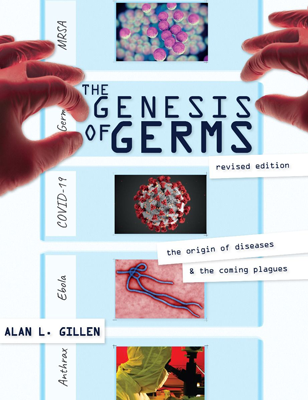
The Genesis of Germs
In The Genesis of Germs, author Professor Alan Gillen shows that constantly mutating diseases are proof for devolution rather than evolution.
Several months ago, friends of mine were planning a trip to Liberia. They were just about to head over when they got the news that there was an Ebola outbreak. At the time, they contacted me to find out just how safe or unsafe it was in Liberia. They knew more about what to expect on the trip to Liberia, but they were unsure of what to expect in terms of Ebola infecting as many people as it had. At the time, the death toll was in the hundreds (recent estimates suggest that the death toll is over 4,000).1 I began trying to help them understand a few things about Ebola so they could make an informed decision. Since that time, I have noticed a number of websites have arisen with misinformation and sensationalism that misleads the public about how severe a threat Ebola is.

Continue reading here:

https://answersingenesis.org/biology/microbiology/where-did-ebola-come-from/

Saturday, October 11, 2014

Little Trees? A Soft Carpet? No, It's a Gecko Foot!

https://answersingenesis.org/kids/animals/making-a-big-deal-out-of-small-things/

You only have to look outside to be struck by the beautiful things God made.
You only have to look outside to be struck by the beautiful things God made. But that beauty doesn’t stop with what your peepers can see. Zooming in with a microscope shows a whole new world of awesome (don’t be surprised if your jaw drops a time or two).

Gecko Foot

Hairy feet may not seem like such a great thing to us. But gecko toes have millions of tiny hairs that split at the ends into even tinier strands. The molecules on the strands latch onto pretty much any surface and help these lizards walk upside down. (click on the above link to read entire article.)

Gecko Feet

Thursday, September 11, 2014

Evolution's Achilles' Heels

http://creation.com/evolutions-achilles-heels
Coming soon from Creation Ministries International!
A major book and DVD documentary project Building on the huge response to 2012’s Question Evolution campaign, we aim to take even more ground in the battle to proclaim the truth of the Bible. CMI’s 2014 offensive will be spearheaded by the release of a milestone book and DVD documentary, called Evolution’s Achilles’ Heels.

NEW Teaser Trailer for Evolution's Achilles' Heels documentary
The purpose of this groundbreaking project is to simply and concisely expose evolution’s fatal weaknesses. Like our 15 Questions for Evolutionists tract, we believe evolution theory has no answer to these weaknesses, once properly explained and understood. The book is like no other work that we are aware of, in that it is authored exclusively by nine Ph.D. scientists. Our hope is that this fact will cause evolutionists to sit up and listen. All of these authors received their doctorates from similar, secular universities as their evolutionary counterparts. Each is a specialist in various fields relevant to the subjects on which they write, such as:
Dr Don Batten
Dr Don Batten
Natural Selection
Dr Jonathan Sarfati
Dr Jonathan Sarfati
Origin of Life
Dr Tas Walker
Dr Tas Walker
Geology
Dr Rob Carter
Dr Rob Carter
Genetics
Dr Jim Mason
Dr Jim Mason
Radiometric Dating
Dr Emil Silvestru
Dr Emil Silvestru
Fossil Record
Dr John Hartnett
Dr John Hartnett
Cosmology
In ancient Greek mythology, the great warrior, Achilles, was dipped into the river Styx by his mother to make him immune from all attacks. Holding him by the ankle, she failed to immerse his heel, and this led to his undoing. In common vernacular, an ‘Achilles’ heel’ describes a fatal weakness in spite of apparent overall strength and invulnerability.
This project will be a very direct demolition of the very pillars of a foundational belief system that underpins our now-secular culture. It’s coupled with the biblical command to reach the lost with the Bible’s Good News. In a nutshell, it’s a comprehensive outreach tool like no other. Our prayer is that this documentary will be seen by millions through television broadcast, engagements in theaters and churches, and millions more through personal DVD distribution.
EAH Logo

An interview with the producers who also play some short snippets from the upcoming documentary.